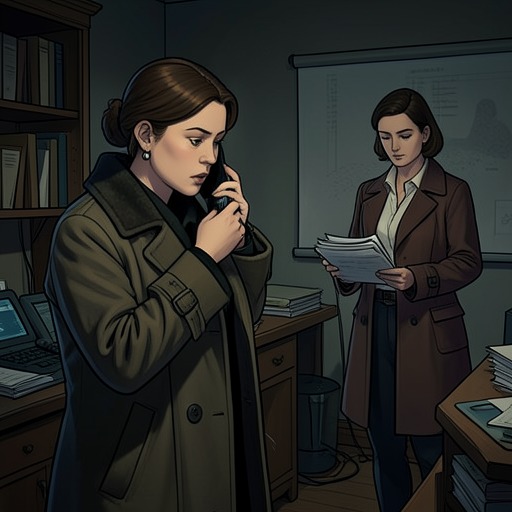
Ravn briefs Smilla at the casino
Smilla's Sense of SnowRavn briefs Smilla at Casino Øresund at the moment her limited freedom is about to close. His account connects the people and operations behind the mystery to heroin trafficking and older intelligence schemes, while his return of the cassette tape gives Smilla back a piece of evidence he had taken from her apartment. Yet he does not offer a clean alliance: he advises her to surrender, and explains his help only through his objection to the unexplained deaths of children.
The Search and the Warning
Ravn appears at the casino in a coat that signals his authority, and asks Smilla for a private word. His presence changes the atmosphere: the people around them stare, while he remains outwardly composed. He says he works a regular shift at the casino one day a week, then answers Smilla’s question about whether they were followed with a more urgent disclosure: the search for her began fifteen minutes earlier.
The casino is not a refuge. Ravn says that a dozen plainclothes officers are always on duty there, alongside the institution’s own representatives. Smilla has only minutes if she stays; if she leaves immediately, Ravn may be able to delay the authorities. He gives her a narrow choice, not a promise of safety. The briefing therefore unfolds under pressure, with Ravn’s practical warning making clear that the information he offers must be weighed against the immediate need to escape.
The Criminal Network
Ravn traces Tørk Hviid’s work to Chiang Rai, describing a heroin trade controlled by powerful regional interests and connected to offices in both the Far East and major Western cities. Hviid, he says, was a microbiologist specializing in radiation mutations. In the opium-growing region, he worked on irradiating poppy seeds to increase yields; rumors credited him with creating Mayam, a preparation said to be twice as strong as any known heroin before crystallization.
Ravn places Katja Claussen and Seidenfaden within the same wider system. Claussen began as an antiques dealer; by 1990 or 1991, it had been discovered that much of the heroin entering the United States and Europe during the 1980s had been smuggled inside antiques. Seidenfaden handled transport. As an engineer specializing in transport assignments, he arranged shipments of antiques from the Far East and for a time ran an airlift from Singapore through Japan to Switzerland, Germany, and Copenhagen, avoiding the risky airspace over the Middle East.
Smilla asks why these people are not in prison. Ravn’s answer is not a legal explanation but a judgment on power: the powerful and the talented are seldom punished. The remark broadens the briefing beyond the mechanics of smuggling. The network’s reach is matched by its capacity to evade consequences, and Ravn offers no indication that exposing its members will itself bring justice.
Freia Film and Greenland
Asked about Freia Film, Ravn explains that the film company served as a cover for German intelligence activity before and during the occupation of Denmark. Under the pretext of filming material to support Horbinger’s Thule theory, it organized two expeditions to Greenland. Their actual aims, as he describes them, were strategic: to assess the possibility of occupying Greenland and securing its two cryolite quarries, whose aluminum production mattered to the aircraft industry, and to survey locations for air bases that could supply a possible invasion of the United States.
This history gives the expedition story a political depth older than the present criminal investigation. The apparent scientific or cinematic purpose concealed plans involving resources, military access, and territorial control. When Smilla asks whether Loyen was a Nazi, Ravn distinguishes political affiliation from personal ambition: he says Loyen was, and remains, obsessed with fame, not politics. His answer does not resolve Loyen’s role in the events, but it redirects attention toward the motive Ravn considers central to him.
The Tape and the Uneasy Alliance
Before Smilla leaves, Ravn takes out a cassette tape. He says he removed it from her apartment to protect her in case of a search. When she reaches for it, he keeps it from her, and she asks why he is helping. His reply is deliberately limited: he does not care for the insufficiently explained deaths of little children. He does not elaborate, and Smilla does not obtain either a fuller account of his motives or the tape in that moment.
Ravn then advises her to visit a friend, invent a plausible explanation for having been aboard the boat, turn herself in to the police, and get a good lawyer. He predicts that she will be free in two days and tells her to forget the rest. The counsel places a sharp limit on his assistance: he protects her from an immediate search and reveals substantial information, but recommends a route that would end her investigation rather than advance it.
Smilla leaves without the cassette, and the encounter closes on that unresolved exchange. Behind her, the casino machine releases a stream of coins with a metallic clatter. The sound accompanies her realization that, at that moment, Ravn has won. When she retrieves her coat, the foyer is empty except for the cloakroom attendant; the mechanic she hopes might have a plan is gone. Ravn’s briefing has widened her understanding of the forces at work, but has not supplied a safe ally, a completed handover, or an escape plan.